The "Nobody Gets What We Do" Problem in B2B



Every founder has had this moment. You explain the company at a dinner, or on a call, or to an investor, and you watch the person's face do a small polite thing that means they've stopped following. They nod. They ask a question that shows they landed somewhere adjacent to what you said. You clarify. They nod again.
The product is good. Customers renew. The people who use it understand exactly what it is. But somewhere between what you built and how you describe it, the thing stops being legible, and you can feel it happening in real time without knowing what to do about it.
That's not a marketing problem and it isn't a design problem. It's a clarity problem, and it's the most common one in B2B.
Why B2B gets this specifically
Consumer companies rarely have this issue. The product does an obvious thing for an obvious person.
B2B breaks that in three ways at once.
The product is genuinely complicated. You're not selling a running app. You're selling something that sits inside a workflow, touches three systems and replaces a process the buyer has done a certain way for a decade. Any honest description is long.
You're selling to a committee. 6sense's 2024 research, based on 2,509 recent B2B buyers, describes buying groups of around eleven people. Gartner puts the average enterprise buying group at five to eleven stakeholders across roughly five business functions, and describes each active member as having the ability to say no. The person who feels the pain isn't the person who signs. The economic buyer cares about a different outcome than the end user, and IT cares about neither.
So the description gets stretched to cover everyone and lands with no one. In CEB's 2015 research, the average B2B buying group included 5.4 stakeholders, and the reported likelihood of reaching a purchase decision with a group that size was 30%. The same research found 46% of customers saying that agreeing on a course of action as a group was highly difficult. Every additional person is another translation your words have to survive, and most of them don't.
The category might not exist yet. If you're genuinely new, there's no shelf to point at. So you borrow language from three adjacent categories and end up sounding like a worse version of all of them.
None of that is a failure. It's the normal condition of an interesting B2B company. But it means clarity doesn't happen on its own, and the default drift is always toward more words.
How to tell that's actually your problem
Plenty of companies think they have a clarity problem when they have a demand problem, and the fixes are different. Four tells that it's clarity:
Your team can't write the same sentence. Ask five people, separately, to write one sentence explaining what the company does. Don't let them confer. If you get five different answers, your customers are getting five different answers too, because those five people are the ones talking to them.
We run a formal version of this on every brand engagement. On a recent merger between two industrial technology companies, six executives completed the same detailed discovery survey independently, with no visibility into each other's answers. Then we consolidated and looked at the overlap. That's the whole method. The overlap between six independent answers is usually the only thing everyone genuinely agrees on, and it's where the real one-liner lives. What sits outside it tends to be somebody's pet framing that never got tested.
Your champion can't sell you internally. You have a great call, real enthusiasm, and then the deal stalls for a month. Usually that means your champion walked into a room with their CFO and couldn't reproduce your pitch. You weren't there. Your words were, and they weren't portable.
This is where most B2B revenue actually goes. Challenger's 2019 study of 667 buyers making complex purchases, 81% of them worth at least $50,000, found that 38% ended in no deal at all. Not lost to a competitor. Lost to nothing happening.
CEB's research puts group conflict at its peak about 37% of the way through the decision, before a salesperson is typically involved at all. And Gartner's buyer survey found buyers spend roughly 17% of their time meeting suppliers, and that's all suppliers combined. If they're evaluating three of you, any one gets about 5%. The rooms where your deal gets decided are rooms you're not in.
A competitor could run your homepage headline unchanged. Read your above-the-fold line and put a competitor's logo next to it. If it still works, it isn't saying anything. Most B2B headlines describe a category, not a company.
Buyers have noticed. Dentsu's 2024 index, built on more than 14,000 buyer interviews, found 68% agreeing that B2B brands have very similar messaging and all sound the same, up eight points from 2021. Reporting on the same index noted that 71% of B2B marketers believed they were communicating a distinct position. That gap, between what the people writing the copy think they're saying and what buyers actually hear, is this entire article in one number.
It's a perception rather than a measurement of literal copy overlap. But perception is the only thing operating when someone is comparing five tabs.
Customers describe you differently than you describe yourself. Listen to a few calls. When a happy customer explains what you do to a colleague, what words do they use? If they're nothing like your website, they've done the translation work you should have done, and every prospect who doesn't already love you has to do it themselves.
Two recent versions of this, both of which arrived as design projects.
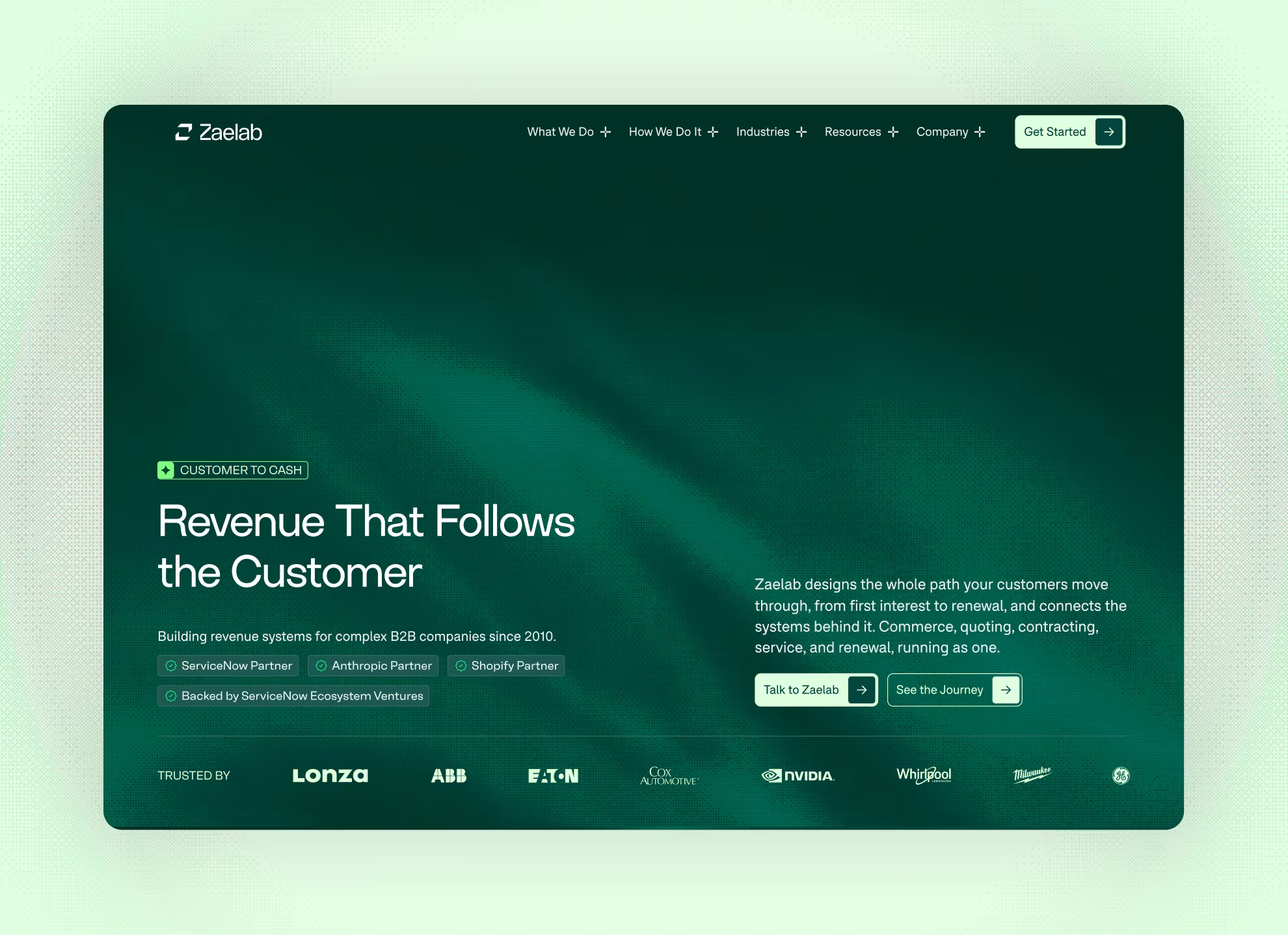
A B2B commerce consultancy came to us with a stalled redesign. They'd been circling visual direction for months and wanted help getting unstuck. Two calls in, the real problem surfaced: the site described a version of the business they'd drifted away from, and it was actively confusing live sales conversations. We stopped the design work and made messaging phase one. The visual direction stopped being difficult almost immediately, because we finally knew what it had to say.
A life sciences software company came in for a refresh timed to a product launch. The brief was cosmetic. What we found was a category problem. They were describing themselves with an industry acronym that made them sound like a generic tool, and prospects had concluded they were too complex and too expensive for smaller projects. Neither was true. The work was naming what they actually specialized in and who it was actually priced for, and none of that was a design task.
Why smart teams end up here
It's almost never carelessness. It's four specific traps, and they're all versions of knowing too much.
You describe the mechanism instead of the outcome. You're proud of how it works, so that's what you lead with. The buyer doesn't care how it works until they care what it does. Mechanism is the second conversation.
You cover every use case. You've got seven, they're all real, and leaving six out feels like lying. So the description expands to hold all of them and immediately stops meaning anything. Breadth reads as vagueness to a stranger.
You use the language of the room you're in. Your team has shorthand. It's efficient internally and opaque externally, and after two years you've lost the ability to hear which words are yours and which are everyone's.
You're describing the company you're building rather than the one you have. The roadmap is exciting. The buyer is evaluating what exists today. When those two get blended, the pitch feels aspirational in a way that makes people suspicious rather than excited.
The fix is subtraction
Here's the part that's hard to accept: almost every clarity problem is solved by saying less, and no founder wants to hear it.
The work is picking one buyer, one problem and one outcome, and letting the rest go on the homepage. Not deleting your other use cases from the business, just from the first sentence. You still sell all seven. You lead with the one that gets someone to keep reading.
That decision is uncomfortable because it feels like closing doors. In practice it does the opposite. A specific sentence gets remembered and repeated. A comprehensive one gets skimmed and forgotten, which means nobody carries it into the next room on your behalf.
Three questions that usually get you there:
- Who is the one person whose day changes most because you exist? Not your whole market. One role, at one kind of company.
- What did they do before you, and what was wrong with it? The old way is the clearest possible frame for the new one.
- What's the outcome they'd tell their boss about? Not the feature. The thing they'd claim credit for.
Answer those three honestly and the sentence usually writes itself. Then the test isn't whether you like it. It's whether someone outside your company can repeat it after hearing it once.
Where that sentence goes is a second decision, and a smaller one. Sometimes it's the headline. More often it sits just beneath a shorter, sharper line and does the actual explaining, or it lives in the deck, the LinkedIn description and the way your team answers the question on calls. What matters is that there's one sentence and everyone is using it. A company with a great headline and four different explanations underneath it has the same problem it started with.
What clear actually sounds like
It's plainer than most founders expect, and that's the discomfort. Clear language can feel underwhelming to the person who's lived inside the problem for years, because it leaves out everything they find interesting.
But you're not writing for yourself. You're writing for a stranger who is skimming, comparing and mostly deciding whether to keep going. Nielsen Norman Group found that users often leave a page within 10 to 20 seconds, and that pages with a clear value proposition hold attention much longer. Their recommendation is blunt: communicate the value proposition inside the first 10 seconds and you earn several minutes.
Clear means a stranger reads it and can tell you who it's for, what it replaces and why it matters. That's a low bar to describe and a hard one to clear, and most B2B homepages don't.
This is where design starts, not where it ends
One thing worth being direct about, because we're a design studio and it would be easy to sell you the wrong thing.
Design can't fix this. A better visual system applied to an unresolved story gives you a more attractive version of the same confusion, and you'll have spent real money to arrive back where you started. That's the most common way a rebrand budget gets wasted.
But the reverse isn't true either. Getting the sentence right and stopping there leaves you with a clear company that looks like everyone else, in a category where looking like everyone else is the default outcome.
The sequence matters. Resolve the story, then build the identity and the site to carry it. Clarity is what makes the craft worth paying for, because now it has something specific to amplify instead of decorating a message nobody can repeat.
If you've read this and recognized your own company, that's usually the hardest part. We do this work for funded tech companies at moments when the story stops being optional. Have a look at how we approach branding, or get in touch and we'll tell you honestly whether the story is your problem or something else is.